20 June 2026
We use the word luck with suspicious generosity.
Someone gets promoted. Lucky.
Someone launches a business at exactly the right moment. Lucky.
Someone prepares carefully, makes a sensible decision, and still loses. Unlucky.
The word is useful. It can explain success, failure, envy, relief, resentment, and surprise without requiring much excavation. It is a small verbal curtain. Once we pull it across an outcome, the investigation tends to end.
That is the problem.
Luck may be a fair description of what happened. But it is rarely a useful diagnosis of why it happened or what to do next.
Luck is not always an answer.
Often, it is the beginning of a better question.
The Two Bad Explanations
We are often trapped between two stories.
The first says everything is luck. Some people are chosen. Others are not. Outcomes arrive, and we receive them.
The second says everything is control. Work hard enough, think correctly enough, build the perfect routine, and reality will eventually sign your preferred contract.
The first story makes us passive.
The second makes us cruel, especially toward ourselves.
If every outcome is luck, effort becomes decorative. If every outcome is control, every failure becomes a confession.
Neither story survives contact with real life.
Good decisions can produce bad outcomes. Bad decisions can win. Preparation matters, but timing matters too. Skill changes the odds, but illness, markets, other people, and plain chaos do not ask permission before entering the room.
We need a view that leaves space for both randomness and agency.
What Do You Mean by Luck?
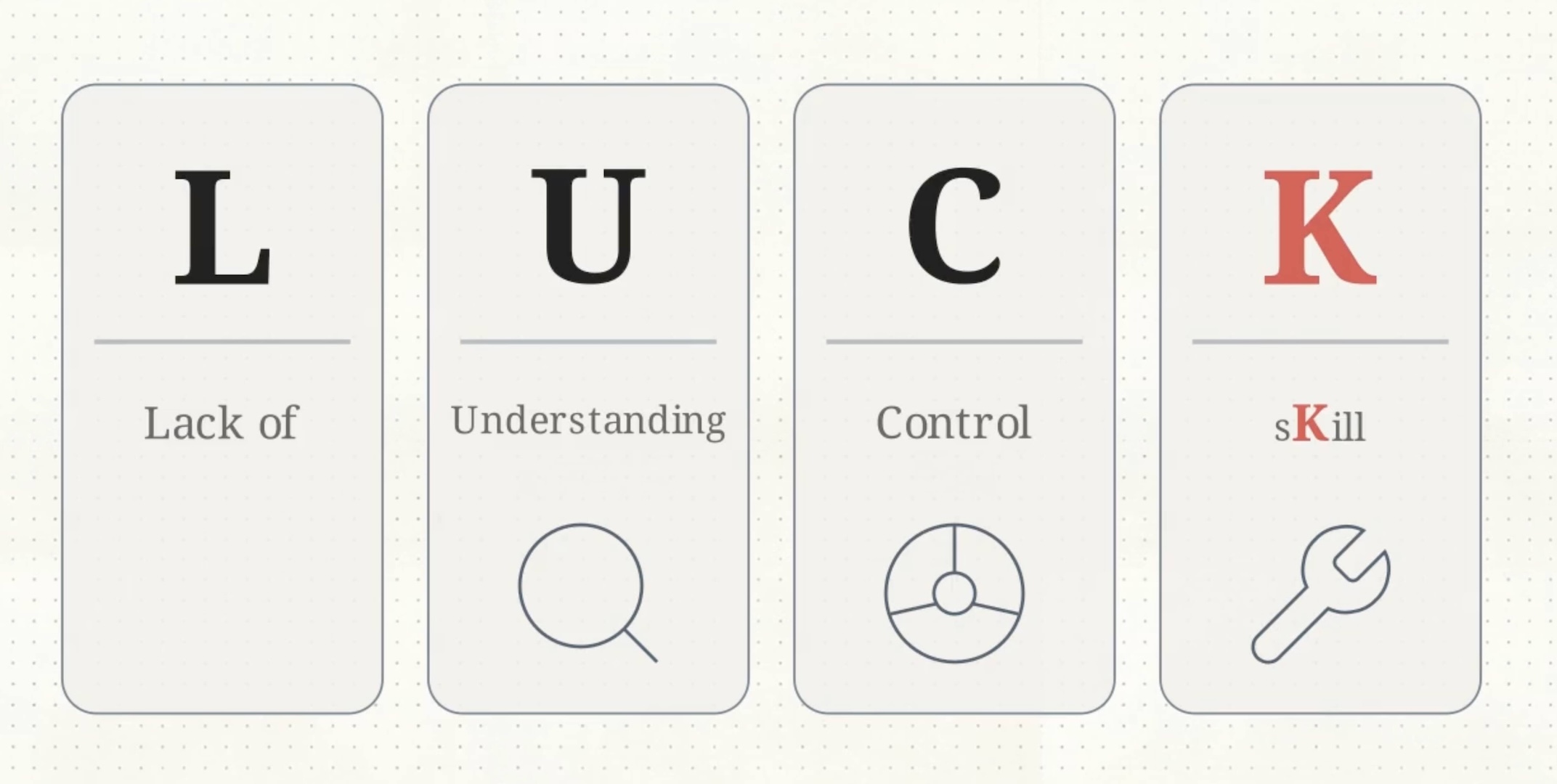
When an outcome feels lucky or unlucky, three practical limits are often mixed together:
Lack of understanding. Important variables may be hidden. You may not understand the system, incentives, timing, or chain of causes that shaped the result.
Lack of control. You may understand the situation but control only part of it. The useful question is not whether you control everything. It is which part you can influence.
Lack of skill. What looks like chance to a beginner may look like pattern, timing, or craft to someone experienced. Skill does not defeat randomness. It makes more of randomness usable.
This is the LUCK framework. The K is doing some unpaid labor, but the idea is simple.
The next time you say, “That was luck,” pause and ask:
What do I not understand?
What can I influence?
What skill would improve my odds next time?
These questions do not explain everything. That is not their job. Their job is to prevent surrendering too early.
A Good Decision Can Still Lose
One of the hardest ideas to accept is that a good process does not guarantee a good outcome.
Imagine two people crossing a busy road. One checks both ways and waits for the light. The other closes their eyes and runs because they are good at trusting destiny.
Both arrive safely.
Same outcome. Very different decisions.
Now imagine the careful person is hit by a driver who runs a red light. The outcome is terrible. The process was still better.
This distinction matters far beyond roads. You can prepare for an interview and not get the job. You can invest carefully and watch the market fall. You can communicate honestly and still lose a relationship.
Probability improves judgment because it separates “Did it work?” from “Was this a sensible way to act under uncertainty?”
You need both questions.
Ignore outcomes and you detach from reality. Worship outcomes and you become a servant of noise.
Improve the Odds, Keep the Mercy
Thinking clearly about luck should make us more responsible and more compassionate at the same time.
More responsible, because odds can often be improved. We can understand the system, build skill, design better structures, become more visible, form stronger relationships, run smaller experiments, and create buffers against foreseeable trouble.
More compassionate, because odds still fail.
Exercise can reduce health risks. It cannot abolish illness. Saving money can improve resilience. It cannot abolish economic shocks. Good communication can improve a relationship. It cannot control another person’s heart.
Agency is not omnipotence.
That sentence protects us from two mistakes: helplessness and self-blame.
When something goes wrong, ask what can be learned. Ask what can be improved. Ask what future action is possible.
But do not automatically turn pain into guilt.
Bad luck is already heavy. It does not need moral luggage that was never yours.
The Daily Question
We cannot control every card that will be drawn.
We can still make better bets.
We can learn one thing that matters. Practice one skill. Repair one relationship. Make one useful signal visible. Remove one bad default. Build one small buffer. Try one experiment. Recover without pretending the loss was secretly a gift.
None of these guarantees success.
They change the slope.
So the most useful question may not be, “Am I lucky?”
It may be:
What can I do today that slightly improves my odds tomorrow?

This essay draws from LUCK: Understand Randomness to Improve Your Odds, a practical inquiry into chance, agency, skill, and resilience. Amazon.